Rachel Maddow makes my day. My friend CN told me about this interview, and I can't remember the last time I was so delighted by TV news. I know I'm a broken record with this issue, but for some reason it galls me, the ignorance of recent history in the gay rights movement. Honestly I don't even think it's that the gay rights movement has taken such a hard right turn in recent years that bothers me as much as the fact that everyone talks about "marriage equality" (don't even get me started on how much I hate that term -- about as much as "pro-life") like it's a progressive cause. If they're going to sign on to this reactionary agenda, at least be clear about what it is.
Maybe the best thing that will come out of the Prop 8 trial is that we will finally be able to straighten out the rhetorical mess. (It occurs to me that perhaps, if the gay marriage people had been honest all along about how conservative their agenda is, they would have made more progress with it by now. Hm.)
I said in a comment to CN's facebook post regarding this interview:
The one consolation is that it makes for a very interesting era for queer politics, which excites the history geek in me. What if the right splits into a religious fanatic wing and a traditional conservative/libertarian wing (which looks sort of likely). The gay marriage people will find themselves allied with the traditional conservatives. Will they be able to stand it? Will the gay rights movement fracture as well, with more tradition-minded gays getting married and being subsumed into mainstream America and the rest of us going off to create a new sexual minority movement of some kind?
I've been reading Rick Jacobs' excellent live-blogging of the Prop 8 trial in San Francisco (Perry v. Schwarzenegger). It's a shame this trial isn't being televised -- not, as so many have said, because it will expose the opposition's argument as a sham; I guess I'm cynical enough to believe that people's opinions about marriage are pretty well entrenched by now -- but because the plaintiff's side is presenting an amazing, concise history of the institutional discrimination against homosexual people in the United States. Most queer people don't know this stuff, let alone heteros. Learn your history, people!
Of course, Anita Bryant came up, and I was curious to see if the famous pie-in-the-face incident was on youtube. It is.
But then I found something even better. A short film, obviously made by stoners, but intended to prevent kids from trying drugs. Delicious.
I started to blog about this Harry Reid thing yesterday, because it was just so outrageous that anyone would believe his comments about Obama were equivalent to Trent Lott's comments about Strom Thurmond. But I scrapped it. They are so obviously not the same, and anyone who doesn't understand that is playing stupid. Or is stupid.
Leaving aside political cynicism, this entire affair proves that the GOP is not simply still infected with the vestiges of white supremacy and racism, but is neither aware of the infection, nor understands the disease. Listening to Liz Cheney explain why Harry Reid's comments were racist, was like listening to me give lessons on the finer points of the comma splice. This a party, rightly or wrongly, regarded by significant portions of the country as a haven for racists. They aren't simply having a hard time re-branding, they don't actually understand how and why they got the tag.
I don't like talking to Republicans for the same reason I don't want to teach 1st grade. I get bored and frustrated having to break everything down, simplify every concept beyond recognition, and still see in their faces that they have absolutely no idea what I'm talking about.
There hasn't been any subbing work at all since before Christmas, but I keep checking every day. And I applied for a full-time position teaching high school speech and theater. I should know about that one this week some time. I think I'd be great at that.
Not sure how I missed this op-ed in last week's Times. And here are some letters in response. I've been subbing and looking for a teaching job, and suddenly most of my friends are teachers, so I've been having a lot of conversations about teaching lately.
I disagree with this writer's gripe about the number of days teachers take off. Almost every time I have a conversation with a non-teacher about teaching, he or she gets around to saying that teachers have a pretty cushy job because they get summers off. For what teachers get paid and for the level of stress, exertion, physical danger, number of extra unpaid hours they put in every week, and the amount of their own money they spend on supplies, a few personal days and summers off every year are the least we can do.
Other than that, though, I agree with most of what the writer says.
My last post started a great conversation, most of which migrated to facebook. My friend M, whose status update during the Texas game the other night spurred me to write my original post, posted a note, an essay, on facebook about her relationship with football fandom. (I think if you're not M's facebook friend, you won't be able to read it.)
This is terribly oversimplifying what was a long, thoughtful rumination, but M's main point is that the joy of being a football fan is that it's fun (and maybe therapeutic?) to be a part of a big crowd all enjoying the same thing. She also made the point -- and this was new to me and illuminating -- that a big part of the fun of being a fan is enjoying one's own performance. It's fun to scream at the TV, to celebrate or commiserate with co-workers the day after a big game, etc. It's a thrill to work yourself up into hysterics, to scream and cry. I get that. It's like fainting at an Elvis concert.
My friend C says she loves football for all the theater that goes on around the game, and she sent me these amazing clips. I love this stuff -- and you don't need any specialized knowledge to get what's going on here. I would've been much more into football if they'd had stuff like this at my high school, but I would probably have left after halftime:
So what is football? It's not just theater, not just spectacle, entertainment. American Idol is hugely popular but still doesn't inspire the fervor that football does. It's not an athletic contest. The Olympics is an athletic contest, and, though people get passionate about it for a week every year, there's not the kind of communal frothing at the mouth you see at a football game. People get passionate for sure about some Olympic events and athletes, but it doesn't even come close to the mass scale of the craziness of football fans.
The only thing I can think of that sets football apart, or above, is the risk of injury, the physical abuse that is tolerated (encouraged? expected? demanded?) by the spectators. As M points out:
Training your body to run really hard into another human being has no athletic benefit whatsover. Players get really hurt and except for the small percentage of them who can make a career out of it (and even those guys, but that involves a longer explanation) are totally exploited (even if they do so willingly and are convinced, at the time, that they are having the greatest time of their lives). Athletic departments, TV networks, and advertisers make billions of dollars off the backs (and shoulders and knees and legs)of teenagers who, if you were to really tally it up, receive very little compensation.
It will take a much more knowledgeable scholar of theater and sports to follow the threads from gladiator games to American football, but it seems to me that the human sacrifice element of the game is essential. Without it, nobody would be interested, right?
My friend M last night in her facebook status update wrote something like "I can't believe this is happening," and I knew right away that it had something to do with football. This time of year in Texas (like during the World Series in New York) I just sort of bear down and wait for people to stop talking about it. (I don't care if they won or lost, just please let it be over.)
From what I understand there was a game last night and Texas lost. People are sad. Other people, obviously, are happy. My first response is something along the lines of "Oh, please, how old are you?" Sports bring out my ungenerous side. I just do not want to hear about it. I can totally channel my mother at the dinner table when I was a little kid railing about how much time and money is spent in schools on sports compared to academics and the arts. And now that I live in a town dominated by a huge university and most of my friends are somehow connected with academia, and I live in a state obsessed with college football, I hear those conversations again. A lot. (The UT football coach makes $5 million a year. Justify that.)
We could trace my negative attitude back to scenes of schoolyard humiliation, gender anxiety, it's all very interesting stuff, but as I've gotten older I've actually made a lot of progress in cultivating a more open and curious attitude toward the sports thing. It's so fucking important to so many people, it has to be interesting in some way. I want to know what it's about. It's like video games and comic books and the Lord of the Rings trilogy. Such a big deal for so many people that I think to be more versed in them would deepen my understanding of the world in some way, so I try to find out, read, ask questions, observe. I try. But it doesn't take long before I'm so lost and bored I think my eyes are going to explode. (The fact that all of the subcultures I mentioned above are traditionally male is not lost on me.)
So. Today everyone is going to be talking about what it was that happened last night. I think, okay I'm going to look it up and at least find out what it was that happened. Not that I have any desire to really engage in a conversation about the game but I at least want to have some very basic context for all the remarks I will overhear. Give me the broad strokes. I go to the New York Times sports section and read the story. Texas lost, that's the gist. And I should have stopped reading there because by the second paragraph I'm totally lost:
"On Texas’ fifth snap of the Bowl Championship Series title game Thursday night, Alabama defensive lineman Marcell Dareus leveled Texas quarterback Colt McCoy with a punishing hit on an option play."
What the hell are they talking about? I'm right back in fifth grade gym class. We're playing flag football; there was never any discussion of the rules, yet I'm expected to know them. It doesn't get any better: "In an era in which spread offenses have come to dominate college football, Alabama’s claim to a 13th national title comes with a game won squarely between the tackles." I get the same feeling reading Foucault. There's nothing unusual or difficult about the sentences grammatically, and the words are familiar. But its meaning is completely opaque to me.
So I'm wondering this: Is there any other field besides sports that is covered in the mainstream media using such arcane jargon? It seems to me that a person who knew very little about, say, food, or politics, or theatre, could read a story about them in the Times and maybe he or she would have to look up a word or two but would be able to follow the story in a general way. Am I right? Since I know a bit about food, politics, and the arts, it's hard for me to judge, but after glancing at a few stories this morning it looks like subjects other than sports are written about in plain language aimed at a general reader, not a specialist. If that it true, then why?
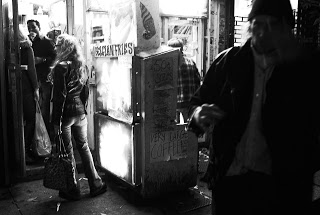
Last time I was in the East Village I noticed that this place was still there and I was I have to admit amazed because pretty much nothing in the East Village is still there. I wondered how it was possible, and I decided the guy must own the building because otherwise how could this little newstand/candy store survive the cultural nuclear bomb they call gentrification in New York? I can't even imagine how high the rent must be for a storefront on Avenue A. Turns out he doesn't own the building, and he's in trouble, and I can't express how sad this story makes me.
J and I met in late May of 1992. We both lived on East 10th St, around the corner and a few short blocks from Ray's. He lived between 1st and 2nd, in the studio apartment that we would eventually share for 6 years. I lived between 1st and A, two doors west of the Russian baths. That first summer, our routine was that we would have sex, then walk to Ray's and get chocolate milkshakes.
(I gained 40 pounds -- let's just say we had a lot of milkshakes -- I grew out of my costume, and I went on Slim-Fast (for real) to lose the weight, but then every sweet romantic story has a dark side, doesn't it?)
We would walk back to my place and sit on the stoop and drink our shakes. We made up the first Y'all songs during those bliss and sugar-fueled evenings on the stoop watching the East Village go by. Boy, that was a long time ago.
Various lists of "most depressing Christmas songs" have been floating around this year. The ones I've seen have been lame, this one the lamest. Andrew Sullivan didn't make a list per se, but he posted several good ones. I know I have a Judy Garland bias, but still I think this one is hard to beat for slit-your-wrists beauty.
After spending every Christmas my whole life with my family until about 2002, I hadn't been to Indiana on Christmas for several years , opting for New Year's Eve instead. Long story why I stopped going, but it mainly had to do with my uncertainty about what constitutes "family." When, for the last two years of my relationship with J (who was always welcomed and loved and cherished by my biological family), we had a third partner, my parents told me I could only bring one partner home for Christmas. Until then, it had never occurred to me that there would be any separation between my acquired and biological families. It was quite a blow. I know my parents didn't mean to hurt me, and the episode was painful for them too. I didn't go home for Christmas that year or any year since then until this one. (J and R and I all spent that Christmas together at a fancy lodge in Aspen, where we had a very high-paying house concert gig for a dinner party of the family of a benefactor.) I hope it doesn't seem as if I hold a grudge against my mom and dad. I know they missed me, but it was a painful time and I didn't want to be reminded every year.
Besides all that drama, my anti-consumerism stance has become more hard-core -- I don't want to poop on anyone's ritual, but I don't want to take part in it either, so I thought it would be best to just not be there for the gift-exchange.
However, the older, more universal aspects of the winter holidays are still important to me to recognize, to observe. The whole longest night rebirth of the sun thing. In some fantasy of my ideal life, I see myself celebrating the solstice with my dearest friends, my acquired, chosen family. But it never quite happened. Friends either avoid the holidays or they have their own traditions, their own family stuff to attend to. So more and more over the last few years I've started to just feel adrift and lonely at Christmastime, which is why this year I decided to spend Christmas with my sister and her family, my mom and dad, and my brother.
On the way there, I was feeling very sad and anxious. I realized that the reason I was going to Indiana was that I didn't have anything keeping me here. My life this year is more unmoored than ever before. I'm living in someone else's house. My financial outlook is more insecure than ever in my life. My career is in a state of flux that feels like stasis.
J avoids Christmas altogether. He was battered by his fundamentalist upbringing. He says he's not anti-Christmas; he just doesn't give it any more weight than President's Day and who can blame him. All the war on Christmas reason for the season idiots? That's what he escaped from.
And J and I have both been dating recently, so, even though J is my family here and will always be my family wherever we might be, our relationship is changing in subtle ways. Our lives are still very intertwined, but we're starting to depend on each other a little less. It's good, but maybe a little scary, a little sad. In the way that, well, life -- if you're honest about it -- is scary and sad. I have some wonderful new friends here, but they're new friends. My oldest dearest friends are scattered all over the country.
So it was nice to see my family. Also hard. My sister and her husband and their 3 boys, though they live about 40 minutes from my mom and dad, do their own stuff, and my brother's girlfriend's cat was dying, so he came to visit without her just for an afternoon. I was with my folks on Christmas Eve -- which used to be our family's big celebration day -- and it was very sweet, but it was just the three of us. I flee the insecurity of my life here only to find the old family rituals dissolving too. I guess you can't go home again for Christmas. And if that wasn't anxiety-provoking enough, just being with my mom and dad turns up my neurotic internal monologue to 11 -- in the sort of ordinary way that I think that happens to everyone.
But something about spending a week with those family anxieties, familiar and old, was strangely orienting, and I returned to Austin tired but not nearly as strung out as I was when I left.
I took this picture of the Indiana countryside from the highway on the way to the airport and posted it to facebook yesterday. This landscape, the sky, the stand of bluish-brown trees, the cornfield that revolves as you drive by, evoke all the longing of my high school years, the loneliness of waiting to become my true self, the yearning for something to happen, never sure that it, whatever it is, would ever happen. That's sort of how I feel now.
Interesting essay in the Times pointing out the ways in which plants demonstrate that they "want" to live just as much as pigs or chickens or we do.
But before we concede the entire moral penthouse to "committed vegetarians" or "strong ethical vegans," we might consider that plants no more aspire to being stir-fried in a wok than a hog aspires to being peppercorn-studded in my Christmas clay pot.
Defensive carnivores always trot out the "what about the plants?" argument when they want to catch vegetarians in an inconsistency. Don't plants have a right to live out their lives and die peacefully of old age instead of being dismembered and thrown into boiling water or roasted alive? The argument often works because so many vegetarians base their choice of diet on the idea that non-human animals have just as much right to live their lives unmolested as humans do. Such a justification for not eating animals leaves you open to a barrage of attacks: "What about all the insects that die when you harvest crops that were their homes and food source? or the microorgamisms that die when you wash your lettuce? What about all the grubs and small mammals that are killed when you till the soil?," etc. etc. etc.
The problem with asking whether plants (or cows, or monkeys, or bacteria, etc.) aspire to live is that it takes too short a view. Of course they aspire to live. Everything living aspires to live; that's sort of the point. I'm not particularly looking forward to being food for worms, but that's what my carcass will end up being. I aspire to live and in order to live I need to eat other living or formerly living things. And worms need to eat too.
It's just a fact that organisms will die so that other organisms can eat. But the world is larger than me, larger than a feedlot of cows, larger than the spinach plant whose leaves I amputate to make a salad. When I decide what to eat, I can't be controlled by any individual organism's aspirations. If I'm thinking about aspirations at all, I try to keep in mind what the world (of which I am a tiny part) wants, what the world needs, in order to survive and stay healthy.
More than any magical innocence or whatever it is you're supposed to get out of it as a child, I vividly remember a couple years of confusion as it began to dawn on me that some kind of deceit was happening but I couldn't figure out yet how it all worked. I don't remember the magic. I remember being worried. I remember being lied to. I remember how embarrassed I felt when I learned the truth.
The "children need magic and wonder in their lives" argument is bullshit. Children find the whole world magical. Seems to me that playing an elaborate practical joke on them at such a young age might actually corrode their sense of real wonder and real mystery.
"You better be good or Santa won't come." Don't you think a great percentage of December behavior problems are actually caused by the manic anticipation of Santa Claus and piles of toys? The ability to blackmail your kids into good behavior for a few weeks (and, really, does it work?) is not a benefit, it's just a desperate effort to break even.
Santa Claus is like circumcision. "Everybody else does it, and we don't want our kid to feel out of place." It's just another thing that we inflict on children because nobody wants to be the first one not to.
When I was in high school, I used to grab the TV section of the Sunday paper and scour the listings for Judy Garland movies. I had read 3 biographies and I had maybe a dozen LPs. I knew all the songs from the movies, knew the plots and co-stars, and knew what tragic thing was happening in Judy's life during the making of each of them, but I had only actually seen 6 or 8. Nobody showed old movies in theaters in Indiana, and they just weren't on TV that often.
Every few months, there'd be an Andy Hardy movie or maybe Judgment at Nuremberg on at midnight or some other odd time. These showings were like precious rare gifts from whatever god looked over homosexual boys, and I would stay up till 4 in the morning if I had to. This was my thing. I have no idea how the Judy Garland obsession started, but it was something I did alone, and it was intense for many years. I would cry, literally cry, if there was a movie listed and I had to, for whatever reason, miss it. They rarely came around again.
In the age of Netflix, I've seen them all. Most of them a few times. To have access to all these clips on youtube now is almost more than I can bear.
Gay marriage is not the "civil rights issue of our time"; I wonder if gay marriage will even get a footnote. Just in terms of scale, the issue of our treatment of non-human animals in the last century is so much more massive than any grievance of any sexual minority. History will judge this age by the way we are treating the animals who trust us to care for them. I've said this before.
We've all read Omnivore's Dilemma by now, we know that the way animals are raised for meat these days is a nightmare. But this is just as monstrous. In fact, I would say it's worse because it's not the behavior of some impenetrable corporate bureaucracy whose power over our lives we don't understand and feel powerless to affect. This is just folks. It's one thing to turn a blind eye to the provenance of that McDonalds burger you eat every day for lunch, quite another thing to seek out a breeder, buy a puppy, then drop it off at a shelter (or in the highway median) when it's not cute anymore. That is a degree of baldfaced evil that I can hardly imagine being capable of, yet people do it every day.
I think I'm a pretty reasonable person. I'm not some howling PETA activist or radical vegan. I'm not even a vegetarian. I understand that things die so other things can eat. In fact, if these people ate the chihuahuas instead of abandoning them for someone else to kill and dispose of, I would find that some degree of evil less.
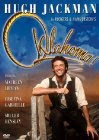
I just watched the Trevor Nunn stage production of Oklahoma! (the one with Hugh Jackman which I think was on Broadway about 10 years ago) on DVD. For the second time this week.
A couple thoughts:
1) Something that long and complex would never make it to Broadway today unless it were some arty Tom Stoppard thing.
2) Popular family entertainment used to be much more adult than it is now. Oklahoma! is steeped in sex and politics and history. Not to mention the fact that it is art of a very high caliber, the highest. Now we have Shrek.
3)Whoever that woman is who played Laurie took my breath away. More than once.
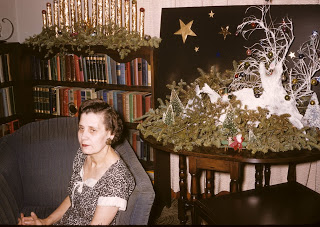
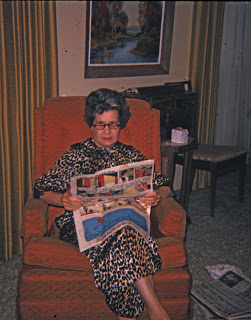
This is Grandma Lenore in 1958, the year my parents were married. She would have been around my age, the age I am now. (Click on the picture to make it bigger -- it's very detailed.)
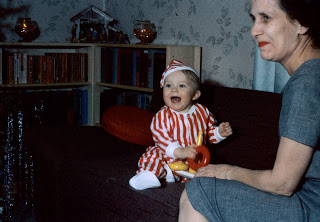
Every year at Christmas she took the Greyhound to Indiana for a long visit, first from Waukegan and later from St. Paul. The trip from St. Paul was quite long, but she wouldn't fly. Some years, especially after she moved to St. Paul, Christmas was the only time we saw her. I adored her, and her visits were the highlight of the year and the best thing about Christmastime.
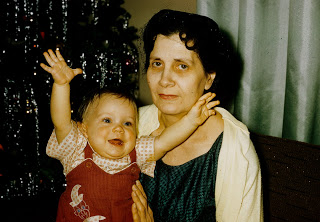
A few years later, by the time of my first memories of her, she favored animal prints and she died her hair black with silver streaks. (That's my sister with her in the kitchen of our house in Indianapolis.)
From Grandma Lenore I got my love of city life, my deep-set eyes, and my bohemian temperament.
There's a blog, called The Bilerico Project, that I usually enjoy more than the other popular GLBT blogs. It has a more serious tone than, say, Towleroad, which, even when he's reporting on serious topics, is pretty superficial.
Towleroad and JoeMyGod are way too gay for me, but the contributors on Bilerico are all over the map, men and women and trans people of various identities and ideologies (but leaning heavily toward scholars and activists). Nancy Polikoff, my anti-marriage hero, is a regular contributor. I don't agree with every writer, but, because I find myself so often at odds with the "gay agenda," I like that Bilerico gives space to dissidents.
Recently, though, there was a profoundly stupid post, by a brand new contributor, which more or less berated people who identify themselves as trans, dismissed the very idea of transgender. (I would link to the post, but it's been removed.) Just why the post ended up there is -- despite reading three days of apologizing, explaining, defending, condemning, and then firing the guy -- somewhat of a mystery to me. It was just so ignorant and insulting, and on a blog that seems to take some pride in the fact that it includes trans voices and, for that reason, I would guess, has a substantial trans readership.
But it sparked a conversation, and that's good. Apparently, most of the Gs, Ls, and Bs still have a lot to learn about the Ts.
I especially appreciated this post -- a sort of "Trans 101" -- for its directness and simplicity, for giving us an armature to hang the conversation on, a place to start. My comment and the response I got from the person who wrote the post are below:
This is great. I love the work you've done to begin creating a taxonomy.
But I wonder where old-fashioned homos fit in this. You have the category "gender variants" ("not heterosexual: this is you"), which would seem to include all homos, but you shy away from explicitly including them under that label. Am I misreading?
I would like to push your argument further and say that we are all trans. Even the homosexuals whose presentation conforms to their biological gender in every way except their erotic orientation.
It's queer orthodoxy to say that gender identity and erotic orientation are two discrete phenomena. I'm always trying to make the argument that that is not true. As I see it, homosexual orientation, in and of itself, is in some meaningful way the same thing as transexuality. They both transgress expectations of gender appropriate behavior. I.e., if you are male and attracted to other males, you are behaving in a way that is only appropriate to women.
I've struggled a lot in the last several years with what to call myself, because "gay" has come to signal a lifestyle I don't want to be a part of. "Queer" is simultaneously too raw and too academic. Even though the way I look is pretty straightforward gender-appropriate male, can I be trans? Is there anything problematic about me calling myself trans?
Hi golikewater :)
Thank you. The taxonomy is useful only beause it has such a broad structure -- something as varied and colorful as the trans community is not easily given ever narrowing structures.
Where do old fashioned homos fit into this? As you noted, descriptively, they would, by being homosexual (or bisexual) fall into the category of Gender Variants at the least, simply because by loving someone of the same sex, they are not conforming to the standard expectations of gender role for someone of their gender expression and identity.
Wich, I have discovered, tends to really upset a lot of gay folks, because its assumed that such is bad.
It is not a bad thing, however, unless you think variance from the normative expectations is bad.
On a personal level (but not so much professioally yet), I actually do think that all of us are Trans.
I believe that you've seen through a lot of the underlying separation -- gender, being a social strucutre that is separate from gender identity, does indeed incorporate one's sexual orientation. Part of being a gay man is being a man (gender) that likes other men (gender).
In my personal and professional estimation, the only risk in calling yourself trans is that by doing so, you may experience a loss of privilege and therefore experience social stigma that is part of the reason I wrote this piece.
Thank you.
So I think I might start calling myself trans. It is more accurate than gay. I have had a life-long internal dialogue about my gender. I didn't know how to be a boy, couldn't walk like them, couldn't tip my chin to say hello. At home I would put on my mother's makeup and wrap towels around myself and tuck my penis between my legs. Even so, I never had the kinds of feelings many transexuals describe of knowing they were girls (or boys, for FTMs). It was acting, just as much as putting on jeans and carrying my books at my side was acting. I wouldn't have used these words at the time, but when I remember how I felt about myself when I was a kid, and even into early adulthood, I felt genderless. I never exactly felt like a girl, but I certainly didn't feel like a boy. My boyness was a tenuous and fragile puppet show.
The real difference as I've gotten older is that I've realized, maybe, that it's always a puppet show, even for the straight boys, and I have come to feel more comfortable being male, to enjoy pulling the strings. There are things about me that are stereotypically male and there are also things that are as girly as it gets.
Nature, nurture, blah, blah, who knows -- why do we feel the need to scienceify everything in order to believe it's true? -- I very much like being both male and female, being something in between.
I know I'm not depressed because don't they always say that when you're depressed you sleep all the time? I can't seem to make myself go to bed at night (even though I have nothing to do but look at all the Loretta Lynn clips on youtube -- there are a lot!) and still I wake up at the crack of dawn every morning lately.
There's not one single thing in this clip that I'm not absolutely in love with right now.
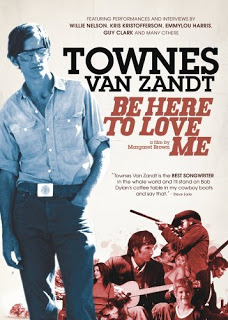
Yesterday, I watched Be Here to Love Me, a documentary about Townes Van Zandt.
Until I saw this film, I had completely forgotten about my first encounter with him and his music. A friend's band opened for him in New York in 1991, or maybe early 1992. I remember my friend telling everyone that if we didn't come to any other show of hers, we had to come to this one because it was a chance to see Townes Van Zandt close up in a small room. I'd never heard of him.
The show was at the Speakeasy, one of the old folk clubs in the West Village, and it was very small, as I remember. We crammed into a tiny room, my friend's band, Pie Alamo, played a short set, and then Townes Van Zandt came out, sat on a stool with his guitar and played a few songs but mostly talked. Long rambling stories; I don't remember what any of them were about. In my memory, it went on for hours. Too long, really. He died a few years after that, and I wish I remembered it more clearly. I wish I could say that such-and-such song blew me away and I remember every word. I don't. I remember the absolute silence in the room more than anything in particular about the songs. I do remember that he was funny and charming but at times incoherent, and that maybe the silence wasn't only reverence for a great artist but fear that he might never find the thread of that story. Or that he might fall off the stool. I'm gonna guess he was pretty drunk, and everyone in the room was completely in love with him.
I'm ashamed to admit that one possible reason I don't remember the evening in much detail is that I was preoccupied with a man. I was there with a date. A guy I had met at a sex club -- the very early incarnation of Michael Wakefield's "He's Gotta Have It" parties, when he was doing them in his East Village loft. This guy was dark and gorgeous and we had had some of the best sex I've ever had in my life, twice, which I guess I thought might translate into a more lasting relationship. (Go ahead and laugh; it was a long time ago.) We went out twice, not counting the 2 encounters at the club. The Townes Van Zandt show was our last date. He left before the show was over. I scoffed.
Not long after that night, I met J, and not long after that, we auditioned for our first gig as Y'all. It was a cabaret event which a small theater company was producing at Flamingo East, a restaurant on Second Ave. J approached them, and they asked us to come sing a couple songs for the directors of the company. We'd been making up songs at home for fun and playing them for friends, but this was the first time we'd presented them to strangers and we were nervous. We walked into the big empty ballroom upstairs (it was mid afternoon) and there were 3 or 4 people sitting at a single table in the corner. We sat opposite them and sang our little set. I played ukulele. I didn't notice until halfway into the first song that one of the people at the table was the sex club guy. He was friendly, I was friendly, but we didn't acknowledge our previous acquaintance. We got the gig, the rest is history.
Oh, and Michael Wakefield, who I didn't know personally at the time, ended up taking the first publicity photos of Y'all. He was a wonderful photographer in addition to successful sex club mogul. Later Michael became a sort of mentor to J and me. One of our early money-making ventures to finance Y'all was to produce our own bi-weekly sex party. I think we had 3 of them. We made pots of money at the first one, but attendance dropped off quickly, and we moved on to other harebrained schemes.
Be Here to Love Me is a beautiful, very sad film about a great American artist. I recommend it. The clip below is not from the film, I just ran across it and it struck me as being very much like I remember him.
First I got stood up. I had a date tonight that I was really looking forward to, with a guy I was very smitten with. He texted at the last minute and canceled.
Then -- I guess it came in yesterday's mail, but I just saw it -- I got a notice that the interest on my credit card is going up to 27.24% because my October payment was late. I have an alarm set on my computer to remind me to make this payment every month, but I was in New York for my show, and I missed it. This is the $15,000 in credit card debt that I racked up finishing my film, Life in a Box, in 2005. Optimism is my enemy. That and, I supposed, spending so much time on art that I don't get paid for.
The first part of the day was quite nice. I had lunch with J and a dear friend from Nashville who was here on business and whom I hadn't seen in a long, long time. And I had a nice visit with a new Austin friend. He helped me figure out a problem with my video editing software, and we talked about men and sex and we bitched about how fucking hard it is to make a living and be happy.
I love my friends.
Update: The payment wasn't late. The default rate kicked in because the minimum payment was $302 and I paid $300 last month. For years I've paid $300/month on that card because $300 was about twice the minimum payment and I wanted the balance to go down, even if slowly. But last month the minimum payment doubled, I didn't notice it, and I paid $2 less than the minimum. Two dollars. I'm not going to blame anyone for my financial woes. Obviously I've brought them on myself with the choices I've made. But two dollars?!