What It All Boils Down To.

This is most of it. It’s virtually all the paper — letters, postcards, legal documents, sales records, scripts, artwork, fan art, flyers, posters, scripts, programs, miscellaneous drafts of things and other ephemera, and photos — and most of the audio (I’ve kept one of all our released albums and singles and the masters, for now). This doesn’t include any of the Life in a Box archives: hard drives with all the media and various rough cuts, the paper logs and storyboards and all that, as well as the 150 hours of raw footage. I want to keep it for a while longer. There’s also quite a bit of digital material, which will be much easier and less anxiety-provoking to transport than these boxes and folders and envelopes.

Other than that, I have the Oshkosh overalls and Red Wing boots I wore in every performance for 10 years. All the handmade shirts and aprons, my grey suit jacket, Jay’s black dress, cameo, and (big sigh) the lucky green dress, were stolen in 2003 from the basement of the friend’s house where Jay was living in Nashville after we separated. We used to say that we were saving the LGD for the Smithsonian, but that’s not to be. I fantasize that 100 years from now it’ll turn up in someone’s attic or in a junk store or estate sale and somebody will recognize it because their grandmother used to go on and on about this bizarre duo called Y’all whose CDs her mother played incessantly in the car when she was a little kid.

Yoga and My Decrepitude.

So for a few years now I’ve had a little to a lot of back pain on evenings after I do laundry or vacuum the apartment and sometimes just randomly when I haven’t done anything strenuous at all. Usually it’s not that bad, but sometimes I’m flat on my back for the rest of the day.

I got out of my gym habit during the pandemic, so I get very little exercise these days except hard New York walking, which is not nothing—I try to walk most places if I can get there in less than about 40 minutes, and even if I take the train I have a 15-20 minute walk to the closest station—but stomping on the pavement is probably not good for my back. Besides the back issue, in general, I can feel my body stiffening. I’ll be 63 in a couple weeks.

Seemed like yoga might be what I need, I kept saying, what I need is core strength and more flexibility, but I put it off and put it off for months, mostly out of social anxiety: going to a new place with new people, starting a new thing with new stuff to learn, feeling dumb, out of my element... The community center in my neighborhood where I go, or used to go, to the gym has a yoga class twice a week. I love this community center, so I finally dragged my ass there (at 7:30 a.m., thank you).

And I started to really enjoy it. I like the teacher, the other people seem nice, the vibe is quiet and mellow, there’s not a lot of socializing. And then the dance studio across the street started offering a class twice a week (at the more reasonable time of 9 a.m), so I tried that one this week and liked it even more.

Since twice a week didn’t feel like quite enough if I want to develop some discipline, I thought I might do both. The community center class is on Mondays and Thursdays at 7:30 and the dance studio class is on Tuesdays and Thursdays at 9, so on Thursdays I’d take 2 classes in a row, but they’re both close to home and it it felt totally doable. Today was the first day I was going to try it out and see if it was too much.

After the 7:30 class, though, as soon as I started walking, my back started to hurt. When I got home I was in pain, I lay down for a while and felt better, but as soon as I tried to get up it was worse. As long as I’m completely immobile (except for my fingers) it’s tolerable, but any movement is pretty painful.

I’m reminded of my favorite Lily Tomlin joke: “The other day I bought a wastebasket, and I brought it home in a paper bag. And when I got home, I put the paper bag in the wastebasket.”

January 1993.

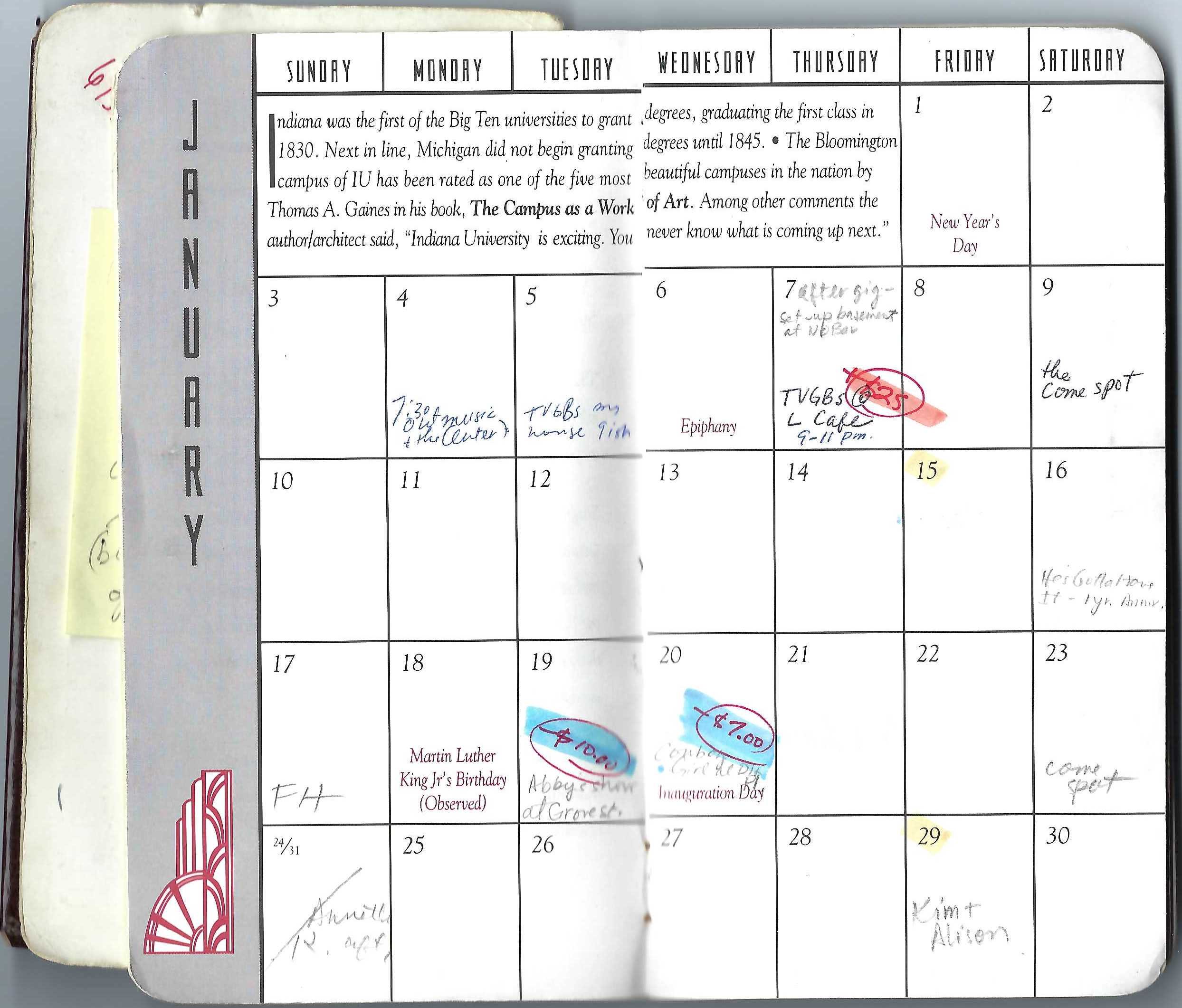
I’m donating the Y’all archive to a university library LGBT collection (I’ll make a real announcement once we’ve signed stuff) and my plan is to deliver a portion of it in person when I’m traversing the Midwest next month doing research. To prepare, I’m trying to sort out and organize what I have, decide what to take. A lot of the material is straightforward: correspondence, press, flyers, photos, legal papers, audio, video. But there’s also quite a bit of random ephemera.

Here’s a page from my 1993 date book. January was kind of slow. We’d been performing for about six months by then. We were mostly doing shows in downtown theater venues like Dixon Place and appearing in the various variety nights of that era (“No Shame” hosted by Home for Contemporary Theater comes to mind), and also doing East Village bar/club-type gigs. I don’t think we’d been swept into the alt-country Rodeo Bar scene yet. The blessing and curse of Y’all was that we fit in everywhere and nowhere.

According to this calendar, we played in the monthly Outmusic night at the Center (we loved those gigs and those fans), and it looks like we were starting to check out the West Village cabaret scene. Later that year we’d do long weekly runs at the Duplex and 55 Grove St. It was an exhausting, insanely fun, creative time. My work has never been quite so singularly focused or quite so open and free.

My previous band, TV Goodbyes, was still playing out, I’m not sure how much longer that lasted. Y’all was kind of a bulldozer. The little notations of money in/money out kind of break my heart. Oh the decades of grinding anxiety about paying the bills. I was 31 (and had very recently declared bankruptcy) when I met Jay and we started Y’all. I still had a few decades to go before I ever made more money at art than I spent making it. I’m proud of my persistence.

Speaking of which—of all my jobs and money-making schemes over all those years, I think the one I find most remarkable was being, for a brief period of time, the proprietor of a twice-monthly sex club called The Come Spot.

Love & Marriage.

Just got butter out to soften so I can make the pink heart-shaped cookies I make every year for Valentine’s Day, because apparently now I am a person who does that sort of thing. And while I wait, I’m contemplating how it all started.

This, from December 2010, is from a few weeks after we met, and this, from March 2011, I wrote a couple months later.

(I’m struck by how frank I was back then when I blogged about men and sex. I guess it’s mostly because in 2010 I’d been single for years and there was a lot more sex drama in my life and it was interesting stuff to write about, and now, well, I’ve been married for 12 years. That part of my life is less newsy. Which is not to say less interesting, but that the kind of news generated by a long marriage is I guess more personal, or I have chosen to keep it personal, to protect it. I have a feeling this is a subject for its own essay!)


Life, Work, the Toilet.

For some reason, every year I believe the story I tell myself in December, the month when everything conspires to keep one from getting anything done, that if I just get through it, January is next, and it’ll be quiet and wide open and productive. But of course January is never wide open; it’s full of all the things one couldn’t get to in December. By which I mean all the things that are not making art and that keep artists from making art.

Last week, I kind of felt like I was getting through the list—re-orienting myself in my book (the scale of it is constantly daunting to me, and after a few days, let alone a month, away from it, it can take days for me to figure out what’s going on), applying for two residencies later in the year, getting the Y’all Xmas record online for streaming (every December I’m reminded that people want it and it’s out of print and unavailable, so this year I vowed to take care of it in January), planning a 10-day Midwest research trip for the spring—and then on Thursday our shower faucet broke, and what was a drip became a steady stream. Whatever sense of equilibrium I thought I had came crashing down, taking my disposition with it.

The maintenance department in our co-op is sometimes helpful, sometimes a clown show, sometimes a Kafkaesque nightmare; this time they wouldn’t touch it, so I watched a bunch of Youtube videos and decided I could fix the faucet myself. But then, with visions seeping into my head of being sued by every resident on the floors below us for flooding their apartments, I chickened out at the last minute. I called a plumber, and five days and a few hundred dollars later our shower works.

I keep saying that being able to write is as much or more an issue of focus and sustained concentration than a simple question of how one fills the 24 hours available in a day. But is it? I know some artists who can use the 20 minutes between a phone call and an errand productively. For me, it’s challenging to get anything done on a day when I have a dentist appointment in the morning and the rest of the day free. There are artists who are crazy driven, have boundless energy and never lose focus, work constantly and fast, and there are artists who are sluggish, tentative, roundabout, fearful. I have my moments in the former category (mostly in collaborative situations), but temperamentally I’m somewhere closer to the latter.

I tend to put everything in two columns: making art and not making art, and often resenting the whole latter category. But the not making art column doesn’t only include plumbing and such; it’s also full of things I want and need in my life: seeing friends, watching a movie with my husband, having my nephew for dinner, getting some exercise, sleeping, that sub-category of things one does to stay healthy physically, emotionally, spiritually.

It’s insanely difficult to discern the line between taking care of yourself and letting yourself off the hook (believe me, I know this). It’s taken years, but I have a glint of self-awareness about it now, and I find myself constantly interrogating my work ethic. Is this moment of just sitting here like a bump on a log a moment of fruitful daydreaming, a moment of opening up my mind to see the problem from a new angle or in a different light? Is this productive? Or am I just fucking lazy and afraid right now? Or do I need to get more exercise so I sleep better and have more energy in the morning?

This morning at 6, Chan flushed the toilet and it didn’t stop flushing. We have tankless toilets in our building. They flush hard and fast so they don’t seem to ever clog, and there’s no tank which is nice when you have a 20 sq. foot bathroom. And I hate toilet tanks. They’re gross. But when our toilet won’t stop flushing, it’s sending gallons of water per second down the sewer. The maintenance office doesn’t open until 8, so our toilet flushed continuously for almost two hours. Needless to say I haven’t done much this morning.

Is This Where We Are?

This piece caught my eye this morning, mostly because I couldn’t have had a more exactly opposite response to the film. But this take is still interesting to me because so many gay men seem to have felt the same way.

The setup—two beautiful, damaged urban gay men struggling to connect—and the tender, moving performances of Andrew Scott (who is always great) and Paul Mescal—made me inclined to forgive an often obvious, and sometimes outright maudlin story. But gradually my mind drifted far away from the characters to mostly trying to solve the puzzle of the plot. By about halfway through, I was just frustrated and irritable. Instead of contemplating the real problems I thought the story was about—how gay people are always on the outside of their families, the essential loneliness of being gay—I left the theater trying to figure out whether it was a dream, or the guy was schizophrenic, or was it a fable or a horror story, and what the hell was that blurry mass of flesh on the bed at the end? I enjoy the former; the latter makes me angry. It’s not that being tricked by a movie is necessarily a bad thing (“I see dead people” was fun), but not this time. If you stripped away all the gimmickry, there is a beautifully written and acted and powerfully moving story of two men yearning to be together despite everything in modern life that wants to prevent that from happening. It posited interesting questions about gay life, implicitly, and directly in the conversations between the two main characters. (I learned later that the film was made by guy who also did the HBO series Looking, which I loved partly because it dealt with similar questions.)

And then there’s Maestro—in the end I just really loved it, it was so beautiful so watch. Big and gorgeous, unabashedly stylized, cinematic. The way it was edited gave me exactly what I miss in so many contemporary films that look like they were edited by 3-year-olds with ADHD. I’m a sucker for a lingering camera, a whole scene in one long uncut static shot you can relax and let your eyes and mind really take in, slowly, every inch of it. And the tracking shots, especially the one near the end, of Bernstein conducting and the camera moves around him. The virtuosity of his performance and of really everything—just rapturous. It seemed to me that everyone involved in this film was working at the highest level of excellence, and that in and of itself is moving.

But there’s something strange at the heart of it. It’s billed as a biopic, but it’s not. It’s a story of a very unconventional marriage, Bernstein’s wife Felicia is the protagonist, and Bernstein’s inner life is kept hidden, except in some scenes where Felicia shares her take on it. I don’t think this is necessarily unintentional. “Leonard Bernstein” is a performance, his life had the quality of myth, unsurprisingly, because it was constructed, by him, by the media, by his admirers and fans. 

Which gets me to what’s on my mind. That idea of such a constructed performance is often a story about celebrity, but it’s also, and more salient here, a story about queer people, a story about the closet. Every “self” is an act of performing and concealing, but the stakes are usually higher and more explicit for queer people. Bernstein was famously “out,” in that he didn’t hide his attraction to men and his affairs. But the public at that time, and in many ways still, didn’t know what to do with a gay man so unless you were in that circle you wouldn’t have known. It wasn’t like “out gay conductor, Leonard Bernstein” in the New York Times.

Bradley Cooper’s performance, intentionally or not, had the feel of something meta, a performance of a performance—interestingly, not unlike Cate Blanchett’s in Tár—which was exactly right for Bernstein, but without seeing its cracks, and we never do, the film fell short of revealing anything very deep or complex about the man. (Felicia was the only truly complex character.) That in itself is moving, the portrayal of a personality so diminished by the closet; but just sad, not tragedy. Tragedy would be seeing what was lost.

So … there’s another film to be made there, and I look forward to it, when (if?) straight people ever come to terms with how they treat queer people, the lives they force us to live so that we don’t make them uncomfortable.

Here’s the thing I don’t have time to really puzzle out this morning: I feel like both these movies are movies about gay men but made for straight people. (All Of Us Strangers was made, I think, by a gay man. The actors, as far as I know, are straight and it’s loosely based on a story about a straight couple. I could be wrong about any of that, if those things even matter.) I think maybe that’s just where we are, in terms of how popular culture deals with queerness now, and that’s not at all a bad thing. Maybe?

Mom Liked Tommy Best.

My memory (which is probably about 60% reliable at this point) tells me that the cable network, TV Land, when it launched in the early 90s, ran the whole season of the Smothers Brothers Comedy Hour and that’s where Jay and I studied their act and began to emulate it. Jay was Tommy, and I was Dick.

I don’t know if that was before or after we started getting compared to them in the press, but it shaped what we did in a huge way. They were the unrivaled masters of a particular mid-century genre of duo comedy, often but not always with singing: George and Gracie Allen, Sonny and Cher, etc., and Jay and I wanted to be everything they were: hilarious, musically legit, old-fashioned enough for your Southern grandmother, subversive enough for the East Village, sweet, political but unthreatening, always the most entertaining act on the bill. We studied how they made each other funny and we wanted to do that.

The Smothers Brothers were one of those culture-changing acts who most people don’t remember now or know who they were, which is sad, but you can see their influence in so much of what came after. Kind of like Y’all (or I like to think so anyway).

New York theatergoing 2023.

I know we see a lot of theater, but I’ve never actually counted before. We saw 20 plays this year! I don’t think that’s more than usual, in fact maybe less since it was a very busy year otherwise, too. There were lots of truly great nights at the theater, a lot of fine but unmemorable ones, and a handful of best forgotten. Pretty good record. If you want to catch the great stuff, you have to risk seeing some not so great. And a few this year were not just highlights of this year but plays and performances and productions for the ages.

My favorites were Eddie Izzard’s Great Expectations (she’s absolutely sui generis, riveting), the Lincoln Center revival of Camelot (everything I want in a musical, and the score sounded glorious), Fat Ham, Wicked (took our niece, she was thrilled, I’d never seen it before and I loved it), the revival of Sweeney Todd (wow), I Can Get It For You Wholesale at CSC, Stereophonic (one of the best plays I’ve ever seen, for real), Appropriate (so exciting to see an honest-to-god great new American play in its Broadway premiere—if there’s any way, don’t miss this one).

Here’s the whole list:

Great Expectations (Eddie Izzard)
Between Riverside and Crazy
Pictures from Home
The Wanderers
Cornelia Street (new musical)
Camelot
Fat Ham
Wicked
Sweeney Todd
Primary Trust
A Simulacrum
Some Like It Hot
Harry Potter and the rest of it whatever it’s called
I Can Get It For You Wholesale
The Refuge Plays
Stereophonic
Witness for the Prosecution (in London)
Spain
Appropriate
I Need That

Fellow Travelers.

So back to Fellow Travelers, now that it’s done — I thought it was kind of amazing.

At first I was really struck by the idea, and successful execution, of a suspenseful and sexy melodrama set in that repressive and often terrifying time and milieu, to use the repression itself to drive the plot and make it sexy. I didn’t expect it to become such a history lesson, which seemed to start around the third episode. I resisted it at first — the exposition of the politics and homophobia of the era felt clumsy and dry at times — but I got used to it, and soon it didn’t bother me at all. I think that to tell a story so dependent on the culture and politics of a specific moment in history, you either have to not explain it and accept a very small audience of those who have that knowledge, or, if you want a mass audience, you need to catch them up quickly.

People barely remember McCarthy and the HUAAC hearings now (shameful, for such a broadly consequential moment in recent history) let alone the “lavender scare,” and I realize more and more that even the most liberal accepting straight people I know usually have little knowledge of gay history and how very recently attitudes, and more importantly laws, persecuting queer people have relaxed, to the extent that they (and not just straight people but often younger queer people) will look at and judge gay life and same-sex relationships from 20, 30, 70 years ago through a lens of how things are now. True also, and maybe even more so, of the early 1980s AIDS years. Even a lot of gay men who were around then don’t remember the timeline very well. So, I was on board for the Wikipedia-ish nature of some of the dialogue.

What I think was new, at least in a TV series made for a general audience, is how this series set out to and mostly succeeded in dramatizing what “the closet” means, how holding such a deep secret, with the stakes of disclosure so severe, the terror of that, how the necessity of that secrecy corrodes everything around it, over generations, relationships, careers, families, including the integrity of our own souls. And how holding that secret together shaped our communities, shaped how we interacted, not only, but crucially, sexually.

Overall, I thought the series was ambitious (and unique in what it set out to do) and mostly lived up to its ambition, beautifully made, and very compelling start to finish. And, I don’t even know, there’s something about Matt Bomer, I’ve always found him almost uncomfortably sexy, like I feel like even if I just look at him too long I’ll do something wrong.

I asked for the book for Christmas. I wonder how it will compare.

Yes, but.

I wrote an application this week for a musical theater development grant. My musical “Jack” has been on the back burner for a few months while I’ve worked on my book, so I was happy to have this grant application draw me back into it. I need money and institutional support to keep it going, so I’m applying for grants. After the reading of the first draft last year, when I found it was way too long and wooly, I pulled it apart, left 2/3 of it on the table, and put the rest back together, streamlined to tell the story more directly.

I’ve fussed with this piece for so long that I’ve ended up with several orphan songs, songs I cut for one reason or another, usually because the character who sang it was cut. There are several. Some of them are very good. What should I do with them? If I were 25, I’d record them myself and release an album on cassette, get a few nice reviews, no sales, and move on. Or maybe try to get a few gigs where singer-songwriters sing,

I get asked fairly often, well, not often like every day, but with enough regularity that it’s a question I should be prepared for and I’m not. The answer is yes, I miss it a lot, but I always find myself saying yes and then babbling for a while about why it’s not likely to happen. There are lots of ways to plot one’s aging; one way is to see it as an accretion of things you miss.

I cut this song because, one, there are a lot of slow, melancholy songs. All I seem to want to write these days, or listen to, if I’m honest, are songs drenched in sad cello, and I have to keep reminding myself that I have a much higher than average appetite for wistful regret. But also I’m not sure what it adds. Maybe some later day I’ll figure out how it works and find a way to put it back in—maybe not. I sure love singing it, though.

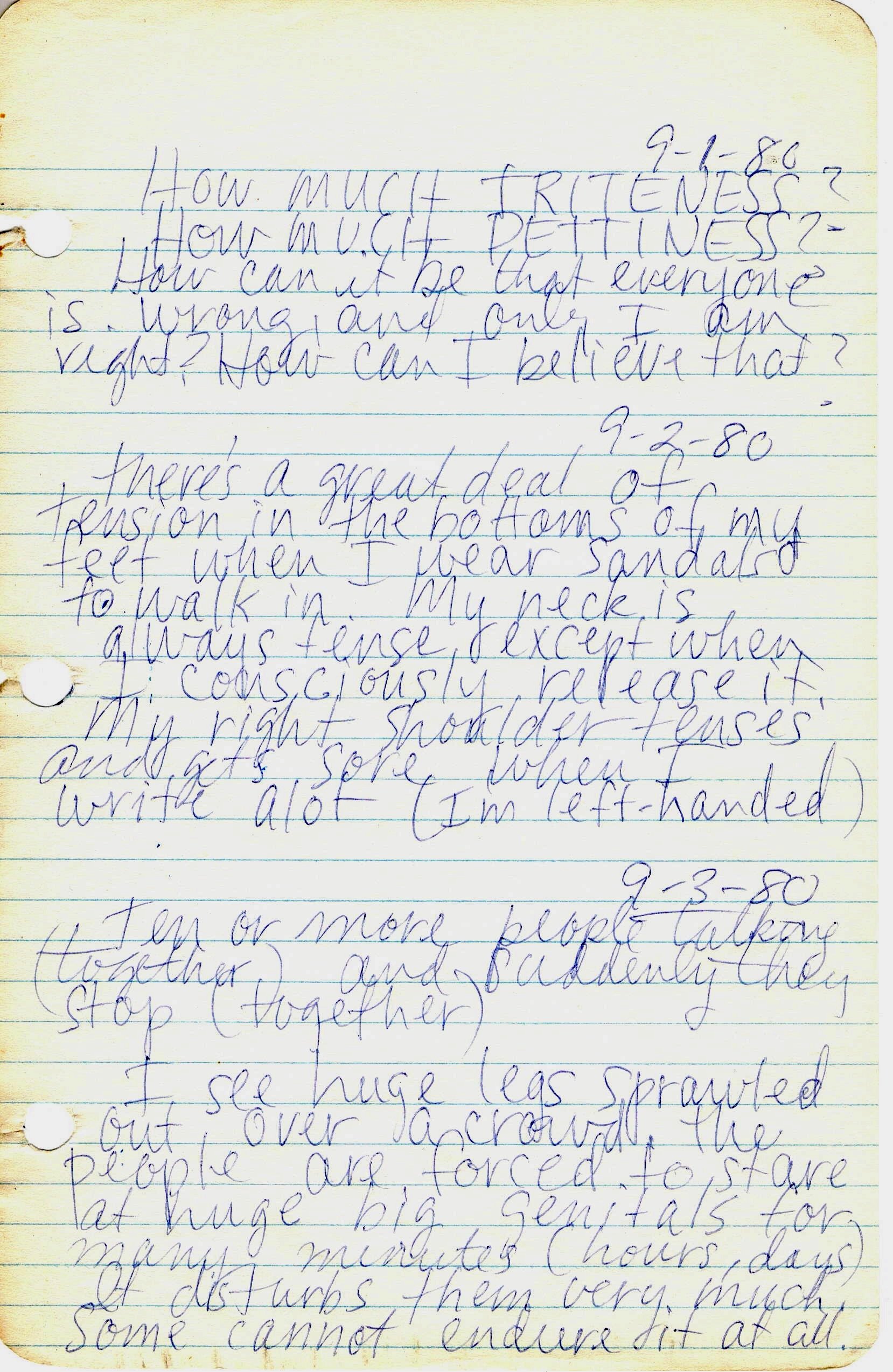
HOW MUCH TRITENESS?

When people ask, “If you could be 18 (or 25, or 12, or whatever) again, would you?” — for me a panic-inducing question because it contains hundreds of questions within it — I always say, “God no!” But, buried for the last three years in the journals and letters and ephemera of my youth, I’ve kind of fallen in love with my 18-year-old self. The world was cracked wide open and I was ready for it, all of it. I was preoccupied, obsessed every moment, with clearing all the accumulated Midwest bullshit and getting on with my life as an artist. I had no patience.

One regret, I guess, that I have, though, related to the question of returning, is that back then, through college, my twenties, especially my late twenties when I started working with theater artists downtown, I had opportunities all around me — in that DIY scene, people were making theater everywhere, putting on their plays, devising performances, adapting, appropriating, experimenting, in their apartments, on the street, in tiny storefronts, abandoned buildings, vacant lots, everybody was up for something weird and new — but I didn’t initiate much of anything. I’m not saying any of it was easy to put together, but you could do it. If you had an idea there were venues, collaborators, an audience. You could try stuff. It’s not that I didn’t have ideas of my own, but they weren’t concrete theatrical ideas. They weren’t “I want to try this on a stage.” I depended on other artists to come in with the framework and then I could contribute. I had tons of ideas, but they were more theoretical than theatrical.

I’ve had, continue to have, a rich and varied career, a huge success by the standards I set for myself as a kid (luckily those standards did not include financial rewards), but something nags at me. I missed a world of opportunities. I could have pushed myself, demanded more of myself as an artist and thinker and writer to find ways to theatricalize the stuff in my head. Now that world of freedom and experimentation is gone. We all turned 30, the rent went up, we had to make more money or leave New York, every marginal, liminal, derelict space was bought up and developed decades ago. Downtown disappeared. If anything like it exists now, which I doubt, it’s not accessible to me.

So maybe I lied, maybe I do wish I could return, but not to my younger self, just to the circumstances of my young life.

Old Songs.

Nice list of great songs made over for a new time.

I was thinking along these lines when If I Loved You, from Carousel, came on during that awful gay rom-com, Red White & Royal Blue, in a cover by a singer called Vagabon (I’d never heard of her, is that because she’s obscure or because I’m old?). It was gorgeous and immediately moving. I downloaded the recording and enjoyed it, I love the airy arrangement, but I probably won’t play it much. Toward the end of the song, she alters the melody in a couple of places in ways that diminish it.

Strangely, I don’t have any trouble with Dolly Parton’s loose approach to the melody in her recording of Let It Be. I think I’d put McCartney is the same category as Richard Rodgers when it comes to just sing the tune as written, but something about the churchiness of Let It Be makes it feel okay.

Non-binary thinking.

I had a sudden insight regarding the label, “non-binary.” I’ve been irritated by it for years, didn’t really get how people were using it, I thought it was an unnecessary, and ugly, word. Some people identifying themselves as non-binary are outwardly, visibly, gender nonconforming in dress and speech, body, affect, what we used to call butch lesbians or nellie queens, bulldykes, sissies. Since to me “gay” and “lesbian” have always included a vast range of gender presentation, most of it nonconforming, I felt like “non-binary” was sort of implied. But others using the label appear conventionally male or female, sometimes even heterosexual. The latter phenomenon is still baffling to me.

I also resisted the word because it has an off-putting scientific, computery smell about it. Some people have the same issue with “homosexual” — they find it antique, clinical — but I like it. Meaning accumulates on words over time, and I think homosexual after a couple centuries has acquired a more complex resonance, warmer than it was when it first appeared in scientific literature. 

First I was gay, then for many years I preferred “queer.” I liked the broader brush of “queer,” the way it included trans and bisexual, men and women. I liked how blunt and confrontational it was. I liked the way it felt to steal the power of a slur. But recently queer has come to be used in a way I don’t, to be honest, really grasp, and yet feel specifically excluded, as a homosexual man, from whatever its umbrella is meant to cover, so I mostly avoid it. I strongly dislike being called “cis.” I think originally cis had a simple technical meaning — a person whose sense of their own gender matched their biological gender — which I guess more or less describes me now, but lately I see the word used to mean something more like a person whose sense of their gender and their presentation of it in the world conform to a stereotypical, essentialist view of gender. Which doesn’t describe me. (And “cis white male” now seems to mean no more than “culprit.” It’s lazy politics and lazy thinking. It’s also snobbery, looking down on people with conventional taste and aspirations, judging certain people to be not queer enough.  My first thought when I hear or see “cis white male” is “yeah fuck you.”)

So, as a person whose life and personality gender- and sexuality-wise are a very mixed bag and more often than not misaligned with society’s expectations of how male-bodied people act, look, and behave, I am non-binary. I don’t mean that in a “this is me!” way. I’m not coming out. Maybe it’s the writer in me, but I don’t see any of these words in terms of some deep characteristic of identity. They’re descriptive words. What’s immutable is my sexual attraction to men. My identity as a gay man is cultural, it’s political. We come together and assert a common identity because it gives us political power. I see non-binary as a broader category, comprising anything that rejects or confounds or debunks or flies in the face of the idea that male and female are separate and opposite, literally “not binary,” and that describes me, so I’ll embrace it. I am gay, I am biologically male, and I am non-binary.

I know that most young people, with their endless appetite for taxonomy and moral certainty, will probably disagree with a lot of this, and that’s okay. I won’t say they’re wrong. But I’m not a young person.

Math.

Doug Miller taught my Algebra II class at Greencastle High School. Everything rode on my grade in his class. Everything. I hated math, despised it, but I had to get an A in that class or I would lose my 4.0 GPA, lose a lot of scholarship money, and not be able to afford to go to college out of state. Getting out of Indiana, away from everyone who knew me, to come out, felt (and I think actually was) necessary.

Mr. Miller was the coach of something, I don't know what sport, I didn't pay attention to that stuff. All my high school math teachers were coaches, as well as my Civics teacher. As a rule, the coaches were terrible teachers, and all of these teachers were, except Mr. Miller, who was kind and patient and able to explain difficult abstract concepts in a way that made them clear and obvious. Which is to say, he knew how to teach.

If I didn’t get an A on the final exam, I would get a B in the class, it was that simple, and Mr. Miller made sure I was prepared.

Usually when I think of the many remarkable teachers I've had over the course of my life, they're art or music or theater, or literature or history teachers, because those are the subjects I’ve always loved and that I naturally excelled at in school. But I'll be forever grateful to Doug Miller for the difference he made in my life at a turning point by simply being excellent at his job.

Ignore the Sourpusses. Go See Camelot.

It made me sad to read a lot of sour reviews of Camelot this morning after being so thrilled and moved by the show only 2 days ago. I feel like what most critics have forgotten, or maybe never knew, is that what makes these great 20th century musicals great is that they are open-hearted, and they are only legible if you go in with your own heart open.

I also didn’t realize until recently (in a conversation about Bartlett Sher’s last revival of a golden age show, My Fair Lady, where I expressed a preference for Alan Jay Lerner over Sondheim) that there’s such a big contingent of Lerner haters out there. I had to smile reading the Times critic (who worships Sondheim) mock Lerner for triple rhymes —he called them “show-offy.” I’ve come to love (a late, qualified love) much of Sondheim, but one thing that still irritates me in his lyrics is all those gratuitous triple, quadruple, quintuple rhymes. 

Camelot is about the power of idealism, about faith in compassion and fairness and justice, in virtue, to transform humanity. This revival with its revised book makes that theme more explicit, but it’s always been about that. Ask Jackie Kennedy. It’s about a steadfast focus on the moral arc, on the future effect of our deeds, in the face of meanness and violence and greed for power in the present. I’m sure for professional critics it’s not easy to reopen the aperture, after a few dozen musicals about teen social anxiety, wide enough to take in such a sweeping theme.

These midcentury shows spoke to and about, not just aging vaudevillians or ambivalent urbanites, but all of us. That’s why they were so popular. We need to constantly re-visit them not just because they are great works of art but because they do something the form has mostly forgotten how to do: ask big social questions which boil down to one question: how do we live together in the world? Maybe critics now, in our contentious, defensive, solipsistic age, don’t think that question is answerable. That conclusion feels so, so bleak to me. “One brief shining moment” indeed.